 TONY MARKS

Hotline Sports
What’s on. Where to watch.
Selected work / Hotline Sports
Making “where can I watch?” a useful answer.
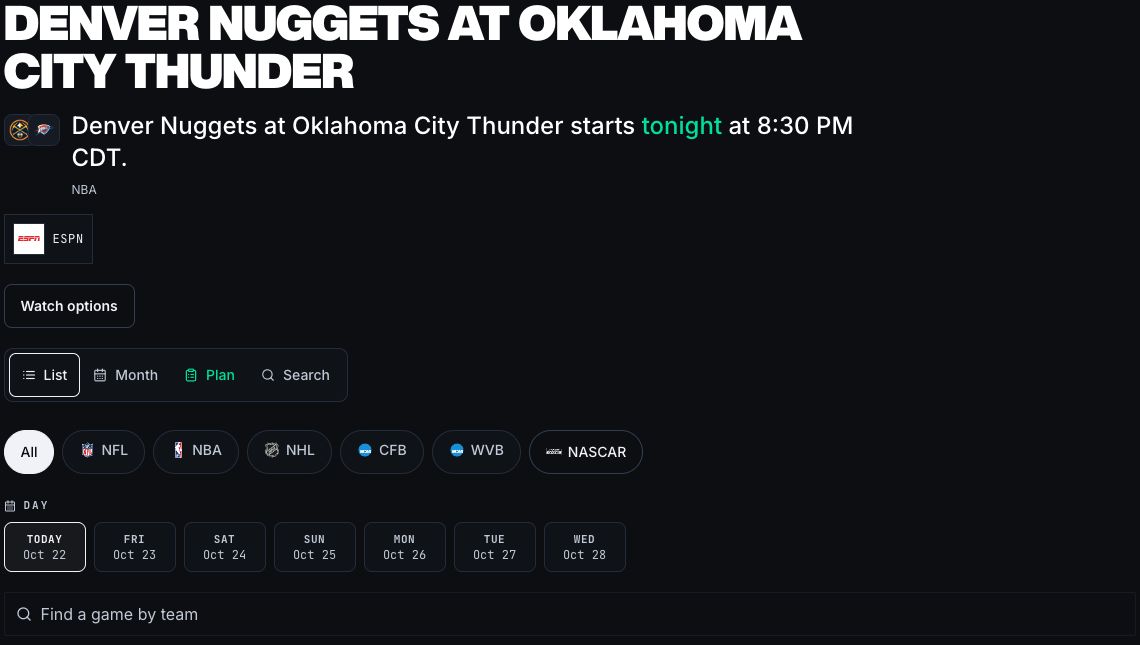
Hotline Sports is a live sports discovery and viewing guide I’m building around a familiar frustration: knowing a game is on doesn’t mean knowing how to watch it.
- My role
- Founder · product direction and development
- Focus
- Sports data · watch intelligence · user experience
- Status
- Live product · continuing development
The challenge
A schedule is only the beginning.
A fan may know the teams and start time and still need to answer several more questions. Which network has the game? Is that channel available in their market? Does their subscription include it? Does a blackout change the answer?
The product needed to connect those questions without making the fan understand the underlying broadcast system. I centered the experience on the next viewing decision: what’s on, what the available information supports, and where to go next.
Product decisions
Put the viewing decision at the front door.
Bring the guide and scores together.
The main guide combines game state, dates, league filters, and viewing information. A visitor can scan live and upcoming events, then open a game for more context. Viewing information belongs beside the matchup, rather than behind a separate research task.
Keep general facts separate from personal access.
“This game airs on ESPN” and “you can watch this game with your services” are different claims. The product separates broadcast information from personalized recommendations, using the fan’s location and selected services where available.
Make uncertainty understandable.
A missing data point should never become a confident recommendation. Market restrictions and viewing caveats stay close to the relevant option. The interface should feel calm while staying honest about what the system can establish.
Under the surface
Four layers, one clear decision.
- 01
Sports data
Normalize schedules, team identities, scores, and game state from external sources.
- 02
Watch intelligence
Connect events to broadcasts, rights, and the services that carry them, with geographic and time-based constraints.
- 03
Personalization
Use a fan’s selected teams, location, and services to make the guide more relevant.
- 04
Presentation
Turn those inputs into a readable guide, game pages, and useful next actions.
The application uses Next.js, Supabase, and Vercel. Behind the interface, normalization and data checks matter as much as the visible design: an upstream channel name or stale assignment can change the answer a fan receives.
Delivery
The work continues after a feature ships.
Sports schedules and broadcast assignments keep moving. The operating work includes ingestion, reviewed data changes, automated checks, and verification against the live consumer experience.
The product is live, with a guide, team and league search, game pages, and personalization. Coverage continues to develop by league and market. A working interface is not a promise that every provider or regional scenario is covered.
The lesson I carry into other AI and data products is simple: the quality of the answer depends on the system behind it. Clear source boundaries, careful modeling, and production verification are part of the user experience.
Start a conversation
Building a product with complex data behind a simple experience?
Tell me what you’re trying to create, who it needs to serve, and where you are today.
Tell me about your project →