 TONY MARKS
Why Is It So Hard to Watch Sports?
A deep dive into 100 years of broadcast complexity—from Harold Arlin’s converted telephone microphone in 1921 to the six-subscription NFL viewing experience of 2026.
It’s Sunday afternoon in October. Your team is playing. You sit down, remote in hand, and start clicking. Is it on CBS? FOX? NBC? Wait—is this a flex game? Is it on ESPN? Maybe it’s on the local affiliate. Or was it moved to Amazon? You pull out your phone, open three different apps, check a Reddit thread, and—seven minutes into the first quarter—you finally find the game. On a service you’re pretty sure you’re already paying for.
Congratulations. You’ve just completed the modern American sports-viewing experience.
This is not an accident. It is the cumulative outcome of 100 years of decisions made by leagues, networks, Congress, and cable companies—almost none of which were made with the fan in mind.
According to Hub Entertainment Research, 90% of sports fans say it is frustrating to figure out where to watch games across TV and streaming platforms. Nearly 25% describe it as “very frustrating.” That number is remarkable on its own. But when you understand the history, it’s a miracle the number isn’t higher.
This is that history. It’s a story about money, technology, antitrust law, and the slow substitution of fan access for rights revenue. It’s a story about a 1961 law that bent the arc of American sports broadcasting toward consolidation and away from the viewer. And it’s a story about why, in 2026, watching the team you love requires a spreadsheet, a law degree, and about five separate monthly subscriptions.
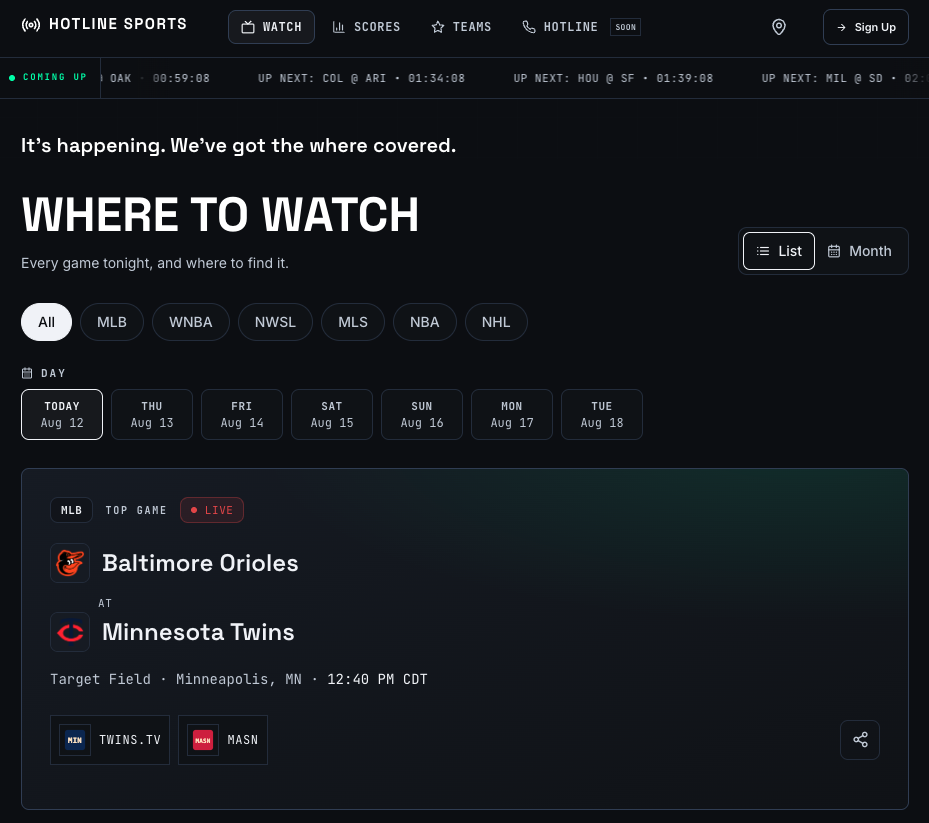
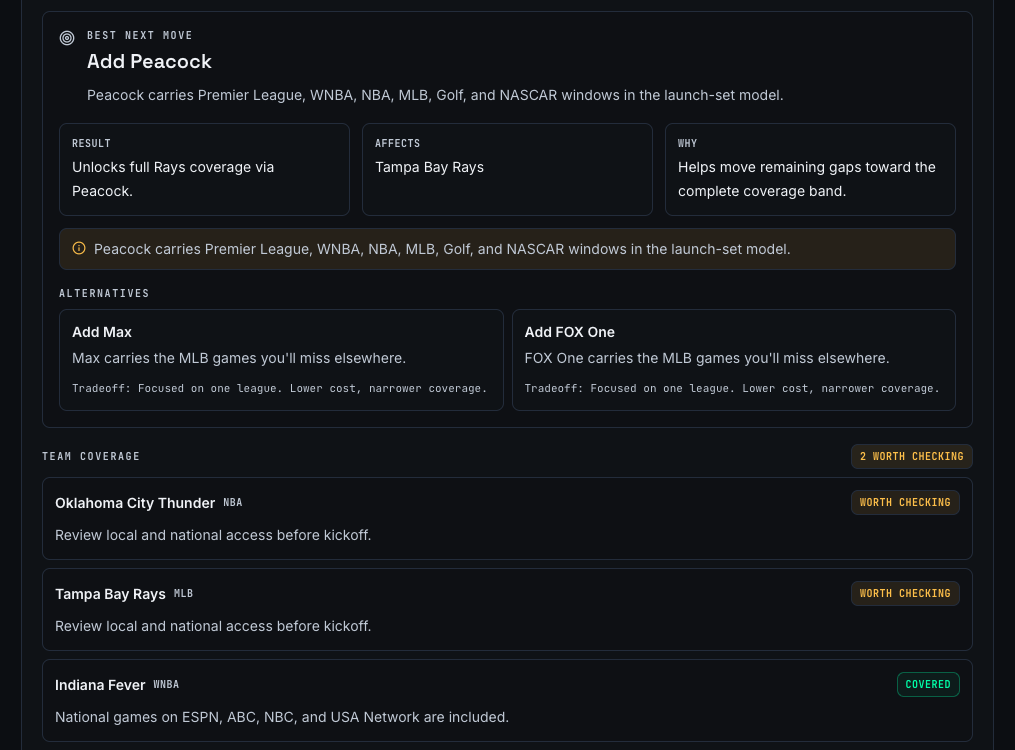
Hotline Sports was built because this problem is real, it is structural, and it is not going away. We are a where-to-watch intelligence engine—for fans trying to find the game, and for venues trying to legally show it. To understand why that matters, you have to understand how we got here.
The Radio Age: When Sports Found Its Voice (1921–1939)
The story begins on April 11, 1921, in Pittsburgh.
Harold Arlin—a 26-year-old station operator at KDKA, the country’s first commercial radio station—sat at a converted telephone microphone and described a boxing match between Johnny Ray and Johnny Dundee. It was the first sports radio broadcast in American history, and almost nobody heard it. Radio receivers were rare, reception was poor, and the idea that millions of people might one day listen to sports in their living rooms would have seemed like science fiction.
It didn’t take long for that fiction to become fact. A few months later, on August 5, 1921, Arlin sat back down at that same converted telephone microphone and called the first baseball game ever broadcast on radio—the Pittsburgh Pirates versus the Philadelphia Phillies. By the end of that same year, RCA had broadcast the World Series. David Sarnoff, the visionary RCA executive who would shape American broadcasting for decades, understood exactly what was happening: “We had to have baseball,” he reportedly said, “in order to sell enough sets to go on to other programming.” Sports weren’t just content. They were the engine driving the entire medium.
The growth was explosive. By 1924, there were 1,400 radio stations across the country, 3 million receivers in American homes, and almost daily sports broadcasts filling the airwaves. In 1934, Ford Motor Company paid $100,000 to sponsor the World Series on radio—one of the first major sports sponsorship deals in history—foreshadowing the trillion-dollar media rights economy that would follow.
Radio made sports democratic. If you had a receiver, you had the game. There were no subscriptions, no blackout policies, no carriage disputes.
Sports leagues—initially skeptical, fearing that broadcast would cannibalize ticket sales—quickly discovered the opposite was true. Radio built fan bases. Radio created national audiences for regional teams. Radio made sports a cultural institution.
That democratic promise would take decades to fully erode. But the erosion had already begun before the first television camera ever pointed at a playing field. On May 17, 1939, NBC broadcast a college baseball game between Columbia and Princeton—the first televised sports event in American history. Approximately 400 television receivers existed in the New York area at the time. The audience was negligible. But the model had been demonstrated. And everyone who mattered in sports and broadcasting was paying attention.
The Television Age: When the Money Started Flowing (1947–1961)
Television arrived in American living rooms after World War II with a speed that startled even its own evangelists. By 1948, the NFL was already broadcasting its championship game on ABC. By 1947, the league had given teams permission to sell local broadcast rights to local stations.
The experiment immediately produced a result that would haunt sports broadcasters for decades: attendance dropped.
The Los Angeles Rams tested home-game television broadcasts in 1950. Season ticket sales fell. The experiment was quickly curtailed. The NFL, spooked, implemented its first broadcasting blackout policy in 1951—any game could be blacked out within 75 miles of the home city. The logic was straightforward: if you could watch it for free at home, why would you pay for a ticket? The tension between broadcast access and gate revenue had been formally institutionalized.
The financial stakes became clear almost immediately. In 1939, the Mutual Broadcasting System had paid the NFL a grand total of $2,500 for the right to broadcast the NFL championship game on radio across 120 stations. By 1951, DuMont Network paid $75,000 to televise the NFL championship game coast-to-coast—the same year NBC produced the first nationwide coast-to-coast college football broadcast (Duke vs. Pitt). In roughly a decade, broadcast rights had increased in value by a factor of 30. The escalator had started moving. It has never stopped.
Then, in 1960, the American Football League—the scrappy upstart competing with the established NFL—signed a groundbreaking deal with ABC worth approximately $2 million per year. What made it revolutionary wasn’t the money. It was the structure: the AFL and ABC agreed to pool all team rights and divide proceeds equally among all franchises. For the first time, a league was selling itself as a single entity rather than a collection of individual teams. Small-market franchises received the same cut as large-market franchises. The model created competitive balance, financial stability, and a template the entire sports industry would adopt.
The NFL noticed. In April 1961, the NFL duplicated the AFL’s structure with CBS. A federal judge promptly blocked it as an antitrust violation. The NFL couldn’t negotiate as a single entity—that was, by law, collusive monopolistic behavior.
So the NFL went to Congress.
The Sports Broadcasting Act of 1961: The Fork in the Road
On September 30, 1961, President John F. Kennedy signed the Sports Broadcasting Act into law.
In six paragraphs, the SBA did something extraordinary: it exempted the NFL, MLB, NBA, and NHL from antitrust law specifically for the purpose of negotiating television rights. The four major professional sports leagues could now collectively pool their broadcast rights, sell them to a single national network as a package, and divide the proceeds equally—activities that would be illegal for virtually any other industry in America.
The stated rationale was equalizing competition between large- and small-market teams. Without pooled rights revenue, the New York Giants could sign a massive TV deal while the Green Bay Packers were left behind, creating an unclosable competitive gap. The SBA was framed as a small, targeted fix to a specific competitive imbalance problem.
It was the most consequential piece of media legislation in American sports history, and almost no one outside the industry has ever heard of it.
In 1962, the NFL signed its first CBS contract under the new law for approximately $10 million. That deal was the foundation of what would ultimately become an $110 billion empire. The SBA didn’t just solve the competitive imbalance problem—it handed leagues an instrument of extraordinary economic power. They could now negotiate from a position of monopolistic strength against any single broadcaster. They could extract maximum value, demand exclusivity, and control distribution in ways that would have been legally impossible in any other industry.
For 64 years, the SBA did its quiet work. Then, in June 2026, the House Judiciary Committee released an interim staff report calling the SBA “A Special-Interest Antitrust Exemption Gone Awry,” concluding that the NFL had stretched the exemption far beyond its original purpose—to the direct detriment of consumers. The fan who can’t figure out which of their six streaming subscriptions carries tonight’s game is, in part, a product of a 1961 law designed to solve a problem that no longer exists.
The fork in the road was 1961. Everything that followed—the cable era, the RSN model, the streaming fragmentation—was built on the foundation laid that September afternoon on the South Lawn of the White House.
The Cable Empire: ESPN and the Balkanization Begins (1979–1990s)
For nearly two decades after the Sports Broadcasting Act, the broadcast sports landscape was actually relatively simple. The major leagues sold national rights to the major broadcast networks. Fans with televisions—which, by the 1970s, meant essentially everyone—could watch national games for free. Local teams appeared on local broadcast affiliates. The system wasn’t perfect, but it was legible.
Then, on September 7, 1979, a startup network launched from a converted warehouse in Bristol, Connecticut.
ESPN—the Entertainment and Sports Programming Network—was conceived by Bill Rasmussen and his son Scott on August 16, 1978. Getty Oil funded it with an 85% stake. In its early days, it broadcast Australian rules football, slow-pitch softball, and collegiate sports that nobody else wanted. The conventional wisdom was that nobody would watch sports 24 hours a day on cable TV.
The conventional wisdom was spectacularly wrong.
ESPN’s breakthrough moment came on March 1, 1979, when the NCAA granted it exclusive cable rights—the first major sports exclusive in cable history. The logic of the ESPN model clicked into place with that single deal: pay fees for exclusive cable rights, require cable distribution to deliver the content, charge cable companies carriage fees to carry the channel, use that money to pay for more rights, and repeat. To watch college sports on cable, you needed ESPN. To get ESPN, you needed a cable subscription. To get a cable subscription, you paid a monthly bill—whether you wanted ESPN’s other programming or not.
By March 15, 1987, ESPN had its first NFL cable contract. By January 5, 1989, it had reached a four-year agreement with MLB. The pay-TV sports model was fully operational.
Meanwhile, something equally significant was happening at the local level. The concept of the Regional Sports Network—a cable channel dedicated exclusively to carrying local team games—had been pioneered by the Madison Square Garden Network, which began broadcasting Knicks and Rangers games in May 1969. SportsChannel New York followed in 1976, evolving into the first modern-style RSN model. By the time Fox Sports Net launched on November 1, 1996, rapidly expanding RSN presence nationally, a complete two-tier system had been constructed: ESPN and the broadcast networks for national games, RSNs for local teams.
The cable bundle that housed this system was the great hidden tax of 20th-century sports fandom. RSNs charged cable companies carriage fees of $3.50 to $8 per subscriber per month—meaning every cable customer in a market paid for the RSN whether they watched it or not. Sports fans subsidized the model. Non-sports fans subsidized it too. Nobody had a choice. The bundle was all-or-nothing, and sports were embedded deep inside it.
The fan had no agency. But at least they had access.
The RSN Era: A Gilded Cage (1990s–2022)
By the peak of the RSN era, the system had achieved a kind of baroque elegance. Every major market had a regional sports network. Every local team had a home on that RSN. National networks carried the marquee matchups. The local-national split felt natural, even inevitable.
The financial dependency was staggering. By 2011, RSNs were integral to the financial health of nearly every major professional franchise. S&P Global data shows the scale: media rights accounted for 54% of total NBA revenue (41% national, 13% local/RSN), 49% of MLB revenue (26% national, 23% local/RSN), and 38% of NHL revenue (19% national, 19% local/RSN). Local RSN deals weren’t supplemental income. They were structural. Teams had built their financial models—player salaries, stadium debt, operational costs—around RSN revenue flowing reliably every year.
Then people started cutting the cord.
Streaming services arrived. Broadband improved. Cable’s bundled model—long protected by inertia and lack of alternatives—started losing customers. RSN carriage fees, which were per-subscriber payments, began declining as subscriber bases shrank. The math that had made RSNs enormously profitable turned against them: high fixed costs (rights fees) combined with shrinking revenue bases (fewer cable subscribers) created an inexorable squeeze.
The denouement came in slow motion, then all at once. Fox Sports Networks—the largest RSN group in the country—was acquired by Diamond Sports Group from Disney in 2019, as the DOJ required the divestiture during Disney’s $71 billion acquisition of 21st Century Fox. Diamond took on significant debt to complete the purchase. On March 31, 2021, the channels were rebranded as Bally Sports, in a sponsorship deal with the casino company. The rebranding felt, in retrospect, like rearranging deck chairs.
On February 15, 2023, Diamond Sports missed a $140 million interest payment. On March 14, 2023, Diamond Sports filed for Chapter 11 bankruptcy. The largest regional sports network operator in America was insolvent. Over the following months, teams began scrambling for alternatives as rights negotiations collapsed. In October 2024, the channels were renamed again—FanDuel Sports Network, in a deal with the gambling company. In February 2026, FanDuel Sports Network lost rights to all nine MLB clubs it had been broadcasting after failing to make payments. Main Street Sports Group, FanDuel Sports Network’s parent company, began issuing WARN Act notices for layoffs and permanent closures. The last RSNs went dark by early May 2026.
Dozens of MLB, NBA, and NHL teams found themselves without a primary local broadcast partner. Some struck direct streaming deals. Some moved games to over-the-air affiliates with limited coverage. Some games simply weren’t available anywhere. The Kansas City Royals’ situation captured the absurdity perfectly: FanDuel Sports Kansas City showed “No Channel Listing” on DirecTV’s channel guide. The team existed. The games were being played. And fans couldn’t find them.
The gilded cage had collapsed. What replaced it was not freedom. It was chaos.
The Escalator
US sports broadcast rights spending, 1939–2030 (projected). From $2,500 to $37 billion.
The Streaming Wars: Every Dollar Chases Its Own App (2020s)
The collapse of the RSN model did not return power to fans. It transferred power to streaming platforms—and the leagues used the transition to extract more money than ever from more sources than ever.
Consider the scale. US sports rights spending was $13.8 billion in 2015. By 2025, it had reached $30.5 billion—a 122% increase in a single decade. S&P Global projects it will reach $37 billion by 2030. Every year, leagues sign deals worth more than the year before, with more platforms, on more exclusive terms.
The NFL, as always, provides the most extreme illustration. The league’s current rights package, running from 2023 to 2034, totals approximately $110 billion over 11 years. The money breaks down across a bewildering array of partners: ESPN/ABC pays $2.7 billion per year for Monday Night Football; CBS pays $2.1 billion per year for Sunday afternoons; FOX pays $2.25 billion for Sunday afternoons; Amazon Prime Video pays $1 billion per year for Thursday Night Football (exclusively); NBC/Peacock pays $2 billion per year for Sunday Night Football; Netflix pays $150 million for Christmas Day games (exclusively); and YouTube TV pays $2 billion per year for NFL Sunday Ticket.
To watch every nationally broadcast NFL game in a given season, a fan needs: a cable or satellite subscription (for CBS, FOX, NBC, and ESPN/ABC), plus Amazon Prime, plus Peacock, plus Netflix, plus YouTube TV. That is five or six separate paid services for a single sport.
The NBA’s new deal, which took effect in the 2025–26 season, distributed games across ESPN/ABC ($2.62 billion per year), NBC/Peacock ($2.45 billion per year), and Amazon Prime Video ($1.8 billion per year)—a total of $76 billion over 11 years, nearly tripling the previous deal’s value. The practical consequence appeared immediately: the first four games of a recent playoff series aired on four different networks—ABC, ESPN, NBC, and Peacock. Four games, four services, four separate login screens.
Major League Soccer chose a different path, signing an exclusive $2.5 billion, 10-year deal with Apple TV+—making it the first major American professional sports league to move entirely off traditional broadcast television. No cable, no broadcast affiliates, no RSNs. Streaming only. It was hailed as visionary by some and criticized as exclusionary by others. Either way, it added another must-have subscription to the list.
And then there are the 96 separate local live game rights deals that exist just for MLB, NBA, NHL, and WNBA teams and local television stations, as S&P Global documents. Each with different terms. Different geographies. Different windows. Different platforms. Ninety-six separate arrangements, each of which must be understood in order to confidently tell a fan whether their local team’s game is available to them tonight.
Leagues have maximized revenue. Fans have maximized confusion. These two outcomes are not a coincidence—they are the same outcome, described from different perspectives.
Blackouts, Disputes, and the Invisible Lines
The blackout policy that the NFL implemented in 1951—preventing local broadcasts of home games—was designed to protect ticket sales. It was a clumsy instrument that made some economic sense in an era when stadium revenue was the primary income stream. Over the following seven decades, it evolved and mutated into a thicket of restrictions that persist to this day, long after the original rationale has dissolved.
The formal FCC blackout rule for NFL games was eliminated in 2014. But the underlying geography of broadcast rights—the invisible market boundaries drawn by decades of rights deals—did not disappear. The NFL’s “home market” and “away market” concepts remain embedded in how rights are sold and how streams are geofenced. Out-of-market packages exist specifically to solve a problem created by those boundaries. The 96 local rights deals each contain their own geographic restrictions. DirecTV offers RSN channels nationally but live games are blacked out outside home markets—meaning you can pay for a channel and still not receive the programming you’re paying for.
Carriage disputes add another layer of unpredictability. These occur when distributors—cable companies, satellite providers, virtual MVPDs—and content owners fail to agree on the fees the distributor must pay to carry a channel. The negotiations are private, the stakes are massive, and the fans are the collateral damage.
In November 2025, Fubo TV dropped all NBCUniversal channels— including coverage of NFL Sunday Night Football and Premier League soccer—over a carriage dispute that left subscribers without content they had specifically paid to receive. Earlier in 2025, a dispute between Disney and YouTube TV blacked out ESPN and ABC for YouTube TV’s approximately 10 million subscribers for two weeks before a deal was reached.
These disputes are not aberrations. They are structural features of a rights market where every party has leverage and no party has a legal obligation to prioritize consumer access. When the deal breaks down, the fan is the one who finds a blank screen.
The result is a broadcast landscape where the answer to “where can I watch this game?” depends not just on which platform holds the rights, but on which distributor you use, which market you live in, whether a carriage contract has recently lapsed, and whether the game is subject to a local blackout, a national blackout, or an out-of-market restriction that nobody bothered to explain in plain English.
The Venue Problem: Why Your Sports Bar Is Also Suffering
Everything described above applies to the individual fan sitting at home. The sports bar operator has a separate and distinctly worse problem.
A business cannot legally show a game using a residential subscription. This is not a terms-of-service technicality—it is copyright law. The subscriber on a home account has purchased personal use rights only. Public performance—showing the content to customers in a commercial setting—requires a separate commercial license, separately negotiated, separately priced.
The commercial licensing infrastructure is exactly as complicated as everything else in this ecosystem. Bars and restaurants must purchase commercial packages from providers like DirecTV for Business, Spectrum Business, or Dish Business. The cost scales with establishment size, number of screens, and the complexity of rights required. One New York City sports bar reportedly pays approximately $100,000 per year to ensure the rights to show every game a customer might walk in and want to see.
The streaming era has made this dramatically more complicated, not less. Commercial licensing was originally designed around a world where all sports content flowed through cable and satellite systems that had clear commercial licensing pathways. Streaming platforms weren’t part of that world—and some of them have been slow to build adequate commercial infrastructure.
The Netflix NFL Christmas Day 2024 games crystallized the problem. DirecTV opted not to pay the six-figure licensing fee required to carry those Netflix games on its commercial platform. Sports bars that wanted to show the games had to obtain access through EverPass—a commercial streaming aggregator that covers Amazon Thursday Night Football, Netflix NFL games, and Peacock games—or simply not show the game at all. EverPass covers some platforms. It does not cover all of them. Venues still need a base cable or satellite subscription for the channels EverPass doesn’t carry, meaning they’re stacking multiple commercial licensing relationships just to cover the full rights landscape.
Then, after the 2025 season, DirecTV ended its partnership with EverPass Media entirely—leaving sports bars facing deep uncertainty about NFL Sunday Ticket commercial access for the 2026 season. The commercial licensing ecosystem, already a labyrinth, had lost one of its key bridges.
The RSN collapse has compounded this further. More than 80% of NBA, MLB, and NHL regular season games are broadcast on local RSNs— the very RSNs that have been collapsing. A bar operator who purchased a commercial RSN package from DirecTV for Business and relied on it to show local baseball or hockey now finds channels with “No Channel Listing” where the games used to be. The rights moved. Nobody sent a memo.
The bar owner who can’t show your team isn’t negligent or cheap. They’re navigating a licensing labyrinth that was never designed to be navigated—it was designed to maximize revenue extraction from every possible distribution point.
Why We’re Building Hotline Sports
The fan deserves an answer, not a scavenger hunt.
That sentence is the founding principle of Hotline Sports. And after a hundred years of sports broadcast history—from Harold Arlin’s converted telephone microphone in Pittsburgh to the six-subscription NFL viewing experience of 2026—it should be clear that the answer is harder to provide than it has any right to be.
The problem is structural and it is getting worse. US sports rights spending is projected to grow from $30.5 billion to more than $37 billion by 2030. New platforms will continue signing exclusive deals. New streaming services will continue fragmenting the rights landscape. The 96 separate local rights deals for MLB, NBA, NHL, and WNBA teams will continue to shift, renew, expire, and migrate. Carriage disputes will continue interrupting access. The commercial licensing ecosystem will continue lagging behind the pace of rights movement.
Hub Entertainment Research found that 60% of fans say they would be more likely to subscribe to a service that consolidates rights to a sport they follow. Jon Giegengack, principal at Hub, said it directly: “Fans will go to great lengths to watch the sports they care about—but that doesn’t mean they enjoy hunting across multiple apps to find them. Services that simplify the experience of watching sports—whether through discovery tools or by consolidating rights to an entire sport—are delivering more value to fans.”
ESPN built a “Where to Watch” discovery tool. Seventy percent of those who’ve used it say it improves their sports viewing experience. That stat is both encouraging and damning—encouraging because it shows that better discovery tools genuinely help, damning because ESPN’s tool only tells you where a game is broadcasting. It can’t tell you whether it’s blacked out in your market. It can’t tell you whether a carriage dispute has just pulled that channel from your provider. It can’t tell you whether the RSN that carried your team’s games last month is still operational. It can’t tell you what a bar owner needs to do to legally show the game on their eight screens.
Hotline Sports is built to answer those questions. We are the intelligence layer between the rights complexity and the person who just wants to watch the game.
That means two distinct user problems, both of which are real and underserved. The first is the consumer: the fan navigating a labyrinth of apps, subscriptions, blackouts, and carriage disputes, trying to find the game on a Sunday afternoon without spending the first quarter looking for it. The second is the venue operator: the bar owner, the restaurant manager, the hotel, the sports club—any commercial establishment that needs to know, with legal certainty, which platforms and licenses they need to carry tonight’s slate of games for their customers.
The Sports Broadcasting Act gave leagues the power to make access complicated. A hundred years of broadcast economics made it more complicated still. Hotline Sports exists to make it simple again.
The promise of Harold Arlin’s first broadcast was a simple one: the game, delivered to anyone who wanted to hear it. That promise was never formally revoked. It was just buried under a century of rights deals, network negotiations, antitrust exemptions, cable bundles, RSN bankruptcies, streaming exclusives, carriage disputes, commercial licensing requirements, and geographic blackout rules.
We’re digging it back out.
Key Takeaways
- 90% of sports fans find it frustrating to figure out where to watch games.
- The Sports Broadcasting Act of 1961 exempted major leagues from antitrust law for TV rights negotiation—the most consequential media legislation in American sports history.
- US sports rights spending grew from $2,500 in 1939 to $30.5 billion in 2025, and is projected to reach $37 billion by 2030.
- The RSN model collapsed by 2026, leaving dozens of teams without a primary local broadcast partner.
- Watching every NFL game now requires five or six separate paid subscriptions.
- 96 separate local live game rights deals exist for MLB, NBA, NHL, and WNBA teams alone.
- Sports bars cannot legally use residential subscriptions and face a commercial licensing labyrinth.
- Hotline Sports is building the intelligence layer between rights complexity and the person who just wants to watch the game.
Hotline Sports Research Team
Where-to-watch intelligence for fans and venues
Hotline Sports is a where-to-watch intelligence engine for sports fans and venues. This document was produced as foundational research for the Hotline Sports editorial and product team.
Back to homepageRelated Field Notes
What “Attention Is All You Need” Actually Changed
The Transformer paper changed AI. More importantly, it changed how I think about building products.
AI Has Entered Its Infrastructure Era
Why the biggest AI story isn’t just the models anymore—it’s the infrastructure, capital, regulation, and businesses being built around them.
AI Brand Visibility
Why AI systems are changing what it means for a company to be discoverable—and why understanding may become more important than ranking.